"Nothing is more powerful than an idea whose time has come."
Alternate Website Access:
ALERT: Flesh-Eating Parasites "NEW WORLD SCREW WORM" Confirmed in Texas
New World Screwworm has been confirmed in Texas for the first time in decades. On June 3, 2026, officials confirmed the first case in a 3-week-old calf in Zavala County.
Share Missouri 1, Missouri 2, Missouri 3, Missouri 4, Missouri 5, Missouri 6, Missouri 7, Missouri 8, Missouri 9, Missouri 10
Jun 4, 2026 As A Man Thinketh PODCAST - Making Sense of Agriculture and Society
In this video, we break down exactly what happened, why containing it in Texas is more difficult than the 2016 Florida outbreak, what movement restrictions are now in place, and what every rancher needs to do right now.
We also cover the current infested zone, how officials are responding with sterile fly releases, and the potential economic impact if this spreads beyond the initial area.
In this video:
What we know about the confirmed case in Zavala County
Why Texas is harder to contain than the Florida Keys outbreak
Current movement restrictions for cattle and livestock
What ranchers inside and outside the zone should be doing
The real economic stakes for Texas producers
If you raise cattle, sheep, goats, or manage land in Texas — especially in South Texas — this is information you need right now.
Important Links:
Texas Animal Health Commission (TAHC) Updates: https://www.tahc.texas.gov
USDA APHIS New World Screwworm Page: https://www.aphis.usda.gov
Report suspected cases immediately to TAHC or your local veterinarian.
Drop your questions and any local reports in the comments below. Stay vigilant and check your animals daily.
If this video was helpful, hit the Like button and Subscribe for more updates on this developing story and other issues affecting rural America.
https://www.youtube.com/watch?v=h804oKG0vRY
Ivermectin Kills New World Screwworms in Both Humans and Animals
|
 |
Ivermectin Kills New World Screwworms in Both Humans and Animals
As New World screwworms emerge in Texas and New Mexico, the evidence suggests ivermectin may be one of the most effective defenses in both animals and humans.
|

| |||||||||||||||


On June 3, 2026, the USDA confirmed the first U.S. case of New World screwworm (Cochliomyia hominivorax) in decades, after larvae were recovered from the umbilical wound of a calf in Zavala County, Texas.
As of June 8, additional confirmed cases have emerged in multiple Texas counties — including La Salle and Gillespie — alongside the first confirmed case in New Mexico, involving a dog in Lea County that had recently traveled from Mexico.
The New World screwworm, eradicated from the United States in 1966, has advanced steadily northward through Central America and Mexico since 2023, producing extensive outbreaks in livestock, pets, and wildlife.
Unlike ordinary flies, New World screwworm larvae are obligate parasites that enter through open wounds and consume living tissue. As the infestation progresses, they produce expanding lesions that can become severe without prompt intervention.
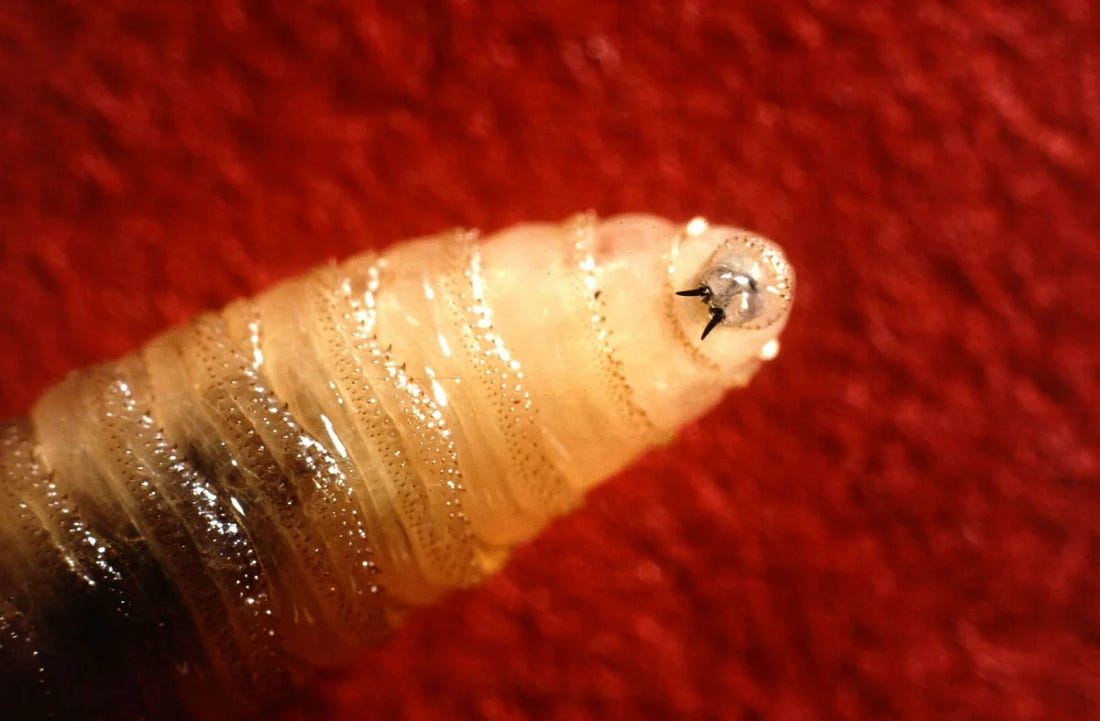 |
So what can be done about it? You guessed it… Ivermectin.
Ivermectin: Proven Activity Against New World Screwworms in Animals and Humans
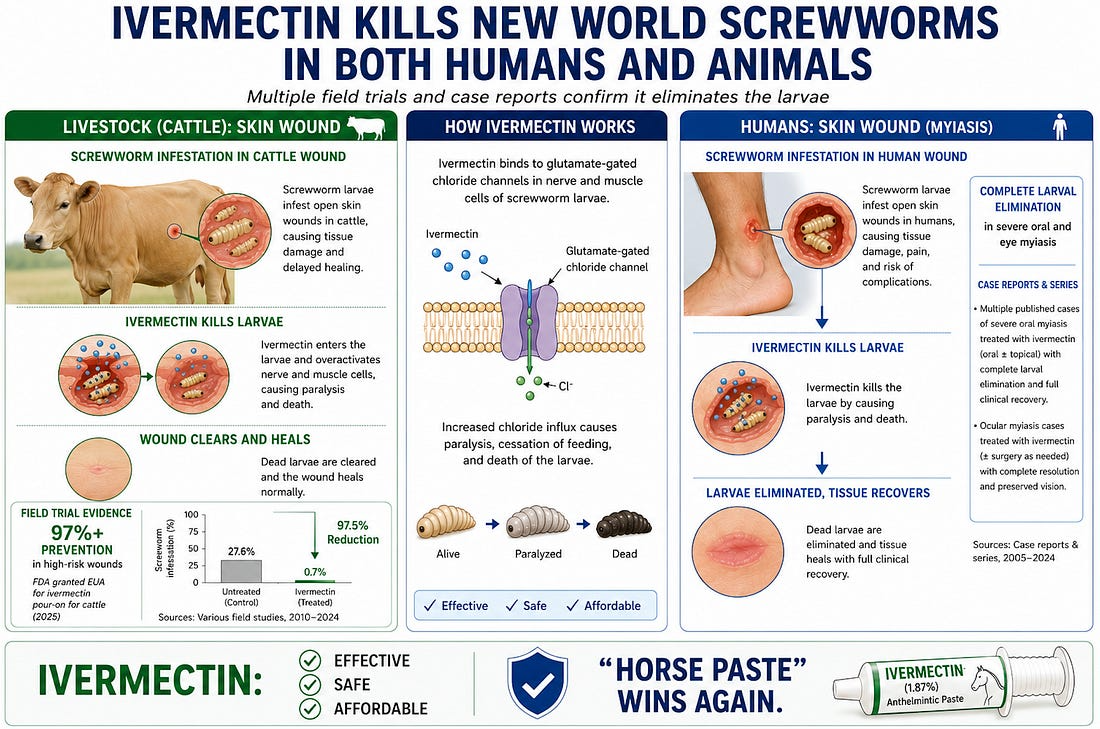 |
Livestock
Ivermectin has shown remarkable effectiveness against New World screwworms in livestock.
In February 2026, the FDA granted an Emergency Use Authorization (EUA) for Ivomec (ivermectin) 1% injectable as an over-the-counter preventive for cattle exposed to screwworm risk — including after birth, castration, or wound detection.
Why? Because 12 field studies conducted in South America — where New World screwworm outbreaks are common — found that ivermectin provided more than 97% protection against screwworm infestations in wounds under real-world conditions.
Researchers found that a single injection could provide 10–21 days of protection, killing young screwworm larvae before they could burrow deeper into living tissue.
Humans
Published case reports suggest ivermectin can be effective when New World screwworms invade wounds in the mouth, eye socket, skin, or other tissues — a condition known as myiasis.
In a 2011 case series involving six patients, doctors treated individuals suffering from severe oral New World screwworm infestations following major facial trauma, where larvae had invaded damaged tissue in and around the mouth. Mechanical removal alone proved difficult because many larvae were deeply embedded in living tissue. Physicians administered subcutaneous ivermectin (200 μg/kg), which killed the remaining larvae and made them substantially easier to remove. All six patients experienced successful recovery without major complications, leading the authors to conclude ivermectin was an effective adjunctive therapy for severe oral infestation.
In a separate 2006 case series involving two patients, physicians treated severe orbital (eye socket) New World screwworm infestation in individuals with underlying skin cancer, where larvae had penetrated tissue surrounding the eye and posed a serious risk of progressive tissue destruction. After receiving oral ivermectin along with wound debridement, the larvae died and could be removed more completely, helping control the infestation and avoid more aggressive surgical intervention. The authors concluded that ivermectin appeared to play an important therapeutic role in severe cases of New World screwworm myiasis.
“Horse paste” wins again.
Epidemiologist and Foundation Administrator, McCullough Foundation
Support our mission: mcculloughfnd.org
Please consider following both the McCullough Foundation and my personal account on X (formerly Twitter) for further content.
FOCAL POINTS (Courageous Discourse™) is a reader-supported publication. To receive new posts and support my work, consider becoming a paid subscriber.
|
 |